Skip to content
Digital marketing gives your business more ways than ever to reach customers.
It also gives you more ways to get lost and overwhelmed.
SEO, websites, branding, content, social media, digital advertising, local search, AI search, email, and analytics can all play important roles. The challenge is knowing where to start, what comes next, and how everything works together.
That is the purpose of this Digital Marketing Roadmap from ItsMoose.com.
This free guide gives Corpus Christi businesses a practical path for building, improving, and measuring their digital marketing strategy.
It doesn’t matter if you’re a startup, mid-size or enterprise business. Whether you are starting from scratch or already investing in marketing, the roadmap can help you identify where your business stands, where opportunities exist, and what you should prioritize next.
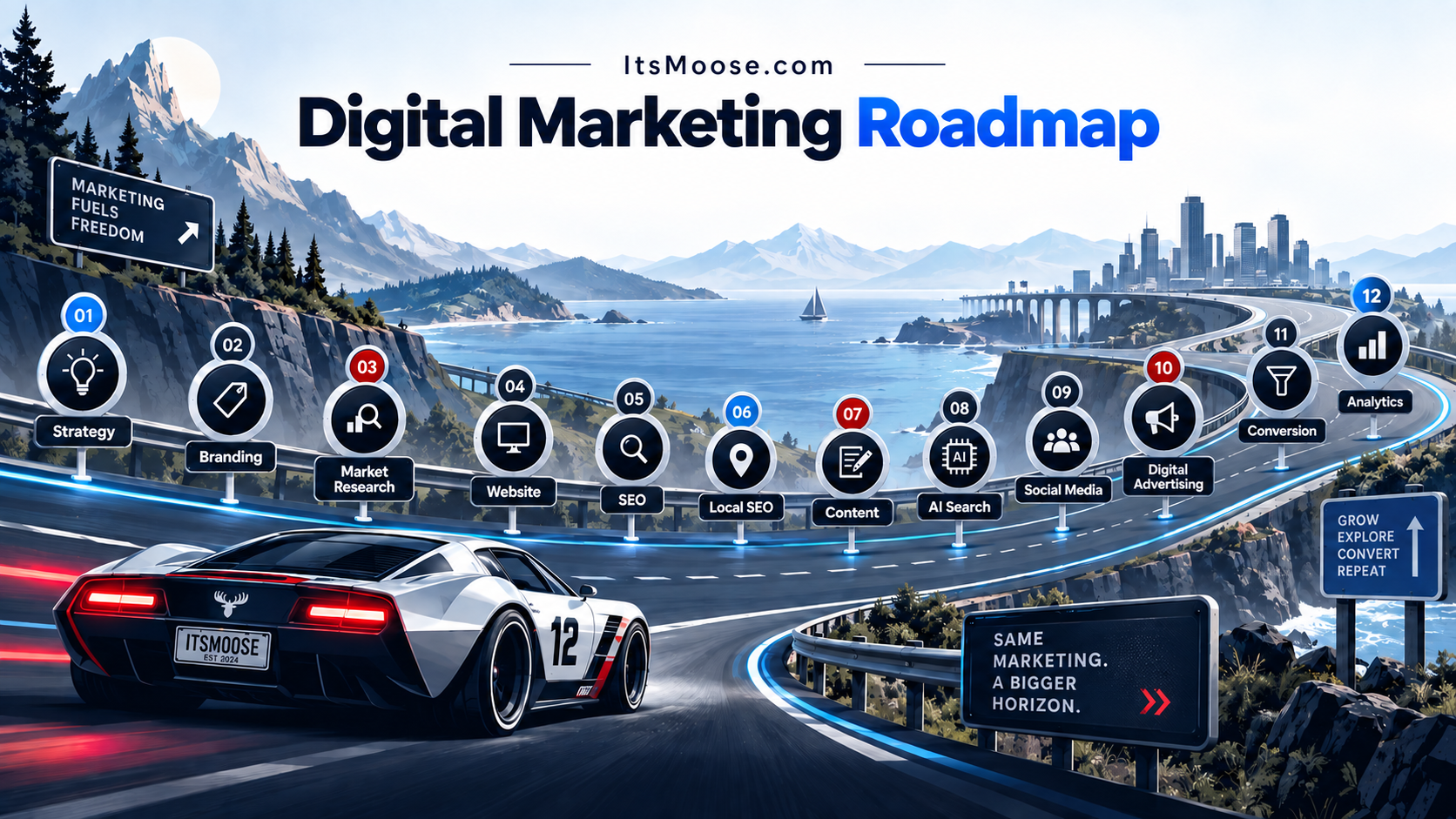
Your roadmap consists of 12 stops, beginning with your business goals and ending with measurement, optimization, and growth.
Each stop builds on the larger marketing system.
You do not necessarily need to start at Stop 1.
An established Corpus Christi business may already have a strong brand and website but need significant SEO improvements. Another company may generate plenty of traffic but struggle to turn visitors into qualified leads.
Use the roadmap to find your position. Then determine your next move.
You do not need to tackle everything at once.
The purpose of this guide is to help you make better marketing decisions in the right order.
At each stop, you will learn what matters, what to evaluate, and what actions can move your business forward. You can then continue to the complete guide for that stage when you need deeper instruction.
Your destination is not more clicks, posts, followers, or marketing activity.
It is a connected digital marketing system that helps the right customers discover your business, trust it, choose it, and come back.
Ready? Steady. . . and go!

Define your goals, audience, budget, KPIs, and what marketing success means for your business.
Understand your competitors, customer demand, market opportunities, and gaps you can pursue.
Strengthen keyword targeting, technical SEO, site architecture, on-page optimization, and search intent.
Create useful service pages, articles, guides, FAQs, videos, and case studies that demonstrate expertise.
Choose the right platforms, establish content pillars, publish consistently, and build meaningful engagement.
Turn visitors and prospects into calls, form submissions, appointments, qualified opportunities, and customers.


Establish your positioning, messaging, value proposition, visual identity, and brand consistency.
Build a fast, credible, user-friendly website designed around customer needs and conversions.
Improve visibility in Corpus Christi through Google Business Profile, Maps, reviews, citations, and local search.
Make your expertise easier to discover, understand, and reference across AI-powered search experiences.
Use paid search, social advertising, retargeting, landing pages, and compelling offers to accelerate growth.
Measure results, identify weaknesses, improve performance, and decide where your marketing should go next.
Define your goals, audience, budget, KPIs, and what marketing success means for your business.
Establish your positioning, messaging, value proposition, visual identity, and brand consistency.
Understand your competitors, customer demand, market opportunities, and gaps you can pursue.
Build a fast, credible, user-friendly website designed around customer needs and conversions.
Strengthen keyword targeting, technical SEO, site architecture, on-page optimization, and search intent.
Improve visibility in Corpus Christi through Google Business Profile, Maps, reviews, citations, and local search.
Create useful service pages, articles, guides, FAQs, videos, and case studies that demonstrate expertise.
Make your expertise easier to discover, understand, and reference across AI-powered search experiences.
Choose the right platforms, establish content pillars, publish consistently, and build meaningful engagement.
Use paid search, social advertising, retargeting, landing pages, and compelling offers to accelerate growth.
Turn visitors and prospects into calls, form submissions, appointments, qualified opportunities, and customers.
Measure results, identify weaknesses, improve performance, and decide where your marketing should go next.
Each stop addresses a critical part of your digital marketing strategy. Explore all 12 to see how they work together, then dive deeper into the areas where your business needs the most attention.
Know where you’re going before choosing the route.
Every effective digital marketing roadmap starts with a destination. Before investing in SEO, advertising, social media, or a new website, define what marketing needs to accomplish for your business.
Start with measurable business and marketing goals. Identify your target customers, priority services or products, geographic markets, available budget, competitive position, and the key performance indicators that will define success. A Corpus Christi business focused on generating qualified leads will need a different strategy than one focused on ecommerce sales, customer retention, or expansion into new Texas markets.
Clear goals also make marketing easier to measure. Instead of asking whether marketing is “working,” you can evaluate progress against specific outcomes.

Key priorities: Business Goals • Target Audience • Marketing Budget • KPIs • Revenue Goals • Growth Objectives
Give customers a reason to remember and choose you.
Your brand is more than your logo. It represents how customers recognize your business, what they expect from it, and why they should choose you instead of another option.
A strong brand strategy defines your positioning, value proposition, messaging, personality, visual identity, and overall customer promise. These elements should remain consistent across your website, advertising, social media, sales materials, signage, email, and other customer touchpoints.
For Corpus Christi businesses, strong branding can be especially valuable in competitive local markets where several companies offer similar products or services. Customers need an understandable reason to prefer one business over another.
Your brand becomes the foundation for everything you communicate throughout the rest of your digital marketing roadmap.
Key priorities: Positioning • Value Proposition • Messaging • Visual Identity • Brand Voice • Consistency
Understand the road before deciding how to compete.
Effective marketing starts with understanding the market around you. Competitive and market research helps identify what customers want, how they search, which businesses already compete for their attention, and where opportunities may exist.
Study your direct and indirect competitors. Review their websites, search visibility, reviews, content, advertising, social presence, positioning, offers, and customer experience. Then look beyond competitors to understand your customers’ questions, problems, expectations, and decision-making factors.
For a Corpus Christi business, research should also account for local demand, neighborhoods, surrounding communities, regional industries, seasonality, and the characteristics that make the Coastal Bend market different.
The goal is not to copy competitors. It is to find opportunities to become more useful, relevant, credible, or distinctive.
Key priorities: Competitors • Customer Demand • Search Behavior • Market Gaps • Local Opportunities • Differentiation
Build the digital home everything else leads back to.
Your website is often the center of your digital marketing system. SEO, Google Ads, social media, email, AI discovery, and other channels frequently lead potential customers back to it.
A strong website must do more than look professional. It should quickly explain who you are, what you offer, who you serve, and what visitors should do next. Navigation should be intuitive, pages should load quickly, mobile usability should be excellent, and important conversion opportunities should be easy to find.
Your website also needs to establish trust through strong content, reviews, credentials, project examples, case studies, photography, and other appropriate proof.
Before investing heavily in generating more traffic, make sure your website is prepared to turn that attention into business opportunities.
Key priorities: User Experience • Mobile Usability • Speed • Credibility • Calls to Action • Conversion
Build the foundation that helps search engines and customers find you.
Search engine optimization helps your website become more visible when potential customers search for the products, services, questions, and solutions related to your business.
A strong SEO foundation begins with understanding search intent and identifying the keywords your customers actually use. Your website then needs a logical architecture, optimized service pages, useful title tags and headings, strong internal linking, crawlable content, and a technically sound experience.
SEO is not about inserting keywords everywhere. It is about creating the best possible connection between what people search for and the information your business provides.
Building this foundation early also strengthens future content marketing and organic growth because every new page becomes part of an organized search strategy rather than another disconnected piece of content.
Key priorities: Keyword Research • Search Intent • Technical SEO • On-Page SEO • Site Architecture • Internal Linking
Get found when customers search for businesses in Corpus Christi.
Local SEO focuses on helping nearby customers discover and evaluate your business through local search results, Google Maps, business listings, reviews, and location-focused searches.
For many Corpus Christi businesses, this is one of the most important stops on the roadmap. Customers frequently search for services using phrases such as “near me,” “Corpus Christi,” or another nearby community before deciding who to contact.
Your local SEO strategy should include an accurate and complete Google Business Profile, consistent business information, relevant categories, customer reviews, local citations, localized website content, and a strong reputation across the web.
The objective goes beyond ranking in Google Maps. Local SEO should make your business easier to discover, understand, trust, and contact whenever local buying intent appears.
Key priorities: Google Business Profile • Google Maps • Reviews • Local Citations • Local Content • Corpus Christi Visibility
Turn your knowledge into an asset customers can discover.
Content marketing helps your business answer questions, demonstrate expertise, build trust, and create additional opportunities for customers to discover you online.
Useful content can include service pages, blog articles, guides, FAQs, case studies, videos, comparison pages, original research, and other resources that address real customer needs. The strongest content strategy is not based on publishing as much as possible. It focuses on creating information your audience genuinely needs throughout the buying journey.
Content also supports several other stops on your roadmap. It strengthens SEO, gives social media something valuable to distribute, supports email campaigns, improves sales conversations, and provides useful information that search engines and AI systems can understand.
Your expertise already exists. Content marketing turns that expertise into a discoverable business asset.
Key priorities: Service Content • Articles • Guides • FAQs • Case Studies • Video • Topical Authority
Prepare your business for the next generation of online discovery.
Customers are no longer discovering businesses through traditional search results alone. AI-powered search and answer experiences are changing how people research questions, compare options, learn about companies, and make purchasing decisions.
AI search optimization focuses on making your business and expertise easier for these systems to understand, verify, and potentially reference. That starts with many familiar fundamentals: clear website structure, useful content, identifiable expertise, consistent business information, authoritative mentions, original information, and trustworthy supporting evidence.
Businesses should not abandon traditional SEO for AI optimization. The two strategies increasingly overlap.
The objective is to build a strong digital presence that can be discovered whether a customer uses conventional search, an AI-generated search experience, or an answer engine to research their next decision.
Key priorities: AI Discovery • Answer Engines • Entity Clarity • Structured Content • Authority • Citations • Trust
Stay visible before customers are ready to search.
Not every customer is actively searching for your product or service today. Social media gives your business opportunities to remain visible, demonstrate expertise, show personality, and build familiarity before a buying decision occurs.
Start by choosing platforms based on your audience rather than trying to maintain a presence everywhere. Then establish content pillars that support your brand and business objectives. Your strategy might include educational content, customer stories, project showcases, short-form video, behind-the-scenes content, community involvement, or company expertise.
For Corpus Christi businesses, social media can also strengthen local connections by highlighting people, partnerships, projects, events, and community involvement.
The goal is not simply to accumulate followers. Build a relevant audience that recognizes your business and has reasons to trust it.
Key priorities: Platform Strategy • Content Pillars • Video • Engagement • Community • Brand Awareness
Accelerate your reach when organic growth is not fast enough.
Digital advertising allows your business to place the right message in front of potential customers through channels such as Google Ads, paid social media, video advertising, and retargeting.
Paid search can capture existing demand from people actively looking for a solution. Paid social can introduce your business to relevant audiences before they search. Retargeting can reconnect with people who previously interacted with your brand.
Successful advertising requires more than launching campaigns. You need clear objectives, strong offers, appropriate audience targeting, relevant landing pages, reliable conversion tracking, and an understanding of what a customer is worth.
The goal is not cheap clicks or impressive impression counts. Advertising should generate qualified opportunities and customers at an acquisition cost your business can sustain profitably.
Key priorities: Google Ads • Paid Social • Retargeting • Offers • Landing Pages • Conversion Tracking • Customer Acquisition Cost
Turn marketing attention into actual business opportunities.
Traffic alone does not grow a business. The people discovering your company must have clear opportunities to take the next step.
Lead generation and conversion connect your marketing activity to actions such as phone calls, form submissions, consultations, appointments, estimates, email subscriptions, purchases, and other meaningful customer interactions.
Start by identifying the conversions that matter most. Then reduce unnecessary friction throughout the customer journey. Strengthen calls to action, simplify forms, improve landing pages, establish trust, respond quickly, and create a reliable process for managing new inquiries.
Your sales and follow-up process matters too. Generating more leads will accomplish little if opportunities are ignored or poorly managed.
The objective is to make it easier for the right prospects to move from interested visitors to qualified customers.
Key priorities: Calls to Action • Landing Pages • Forms • Lead Capture • CRM • Follow-Up • Conversion Rate
Measure the journey, improve the route, and choose your next destination.
Digital marketing is never truly finished. Customer behavior changes, competitors adapt, platforms evolve, AI changes discovery, and your own business develops new priorities.
Analytics helps you understand what is actually happening. Track meaningful outcomes such as qualified leads, customers, revenue, conversion rates, customer acquisition cost, and return on marketing investment alongside the supporting metrics that explain performance.
Then use that information to identify weaknesses and opportunities. You may need to improve a landing page, shift advertising budgets, update content, strengthen local visibility, repair tracking, or focus on a different customer segment.
The final stop therefore sends you back into the roadmap. Measure what happened, learn from it, determine your biggest constraint, and choose the next improvement that moves your business forward.
Key priorities: Analytics • KPIs • Attribution • Conversion Rates • ROI • Testing • Continuous Improvement
The 12 stops are not independent marketing tactics. They work together.
Your goals determine what marketing needs to accomplish. Your brand and market research determine how you compete. Your website gives those strategies a digital home.
SEO and local SEO help customers find you. Content and AI search optimization make your expertise easier to discover and understand. Social media and digital advertising expand your reach.
Then lead generation and conversion turn attention into business opportunities.
Finally, analytics and optimization show you what is working, what needs improvement, and where you should go next.
That creates a continuous cycle for planning, building, measuring, and improving.
Before deciding where to go next, determine where your business stands today.
The Digital Marketing Roadmap Scorecard is a simple self-assessment designed to help you evaluate your business across all 12 stops of the roadmap.
You will score areas such as your brand strategy, website, SEO, local search visibility, content, AI search readiness, social media, digital advertising, lead generation, and analytics.
The goal is not to achieve a perfect score.
It is to identify your strongest areas, biggest gaps, and highest-priority opportunities.
Your results can help reveal where marketing resources may be better spent. You might discover that generating more website traffic is less important than improving conversions. You may find that your website is strong, but your local SEO needs attention. Or your biggest opportunity may be better measurement of the marketing you already have.
Once you know where the gaps are, you can make better decisions about what comes next.
Download the free Digital Marketing Roadmap Scorecard and assess your business across all 12 stops.
Use your results to identify your biggest opportunities and choose the priorities that belong in your next 90-day marketing plan.
A roadmap shows you where to go. A plan helps you get there.
After completing your Digital Marketing Roadmap Scorecard, you may identify several areas that need attention. Resist the temptation to tackle everything at once.
Instead, choose the three priorities that could make the greatest impact on your business over the next 90 days.
Your priorities might include improving your website, strengthening local SEO, creating better content, launching a digital advertising campaign, increasing conversion rates, or finally establishing reliable marketing analytics.
For each priority, determine:
This turns your digital marketing roadmap into an actionable plan with clear responsibilities and measurable outcomes. At the end of 90 days, review your progress, return to your roadmap, and identify the next priorities. Marketing success rarely comes from doing everything at once. It comes from consistently making the right improvements in the right order.
Download our free 90-Day Digital Marketing Plan to choose your priorities, assign responsibilities, establish deadlines, define KPIs, and turn your roadmap into action.
Oftentimes many business owners are overwhelmed and not sure what they need to help grow their business. They think they need Facebook and Google Ads to capture leads, but they don’t have a strong brand or have a poor website to support those initiatives. A digital marketing roadmap is a strategic plan that organizes your digital marketing priorities, channels, and initiatives into a logical sequence. It helps determine what your business should focus on, when those activities should happen, and how success will be measured.
A comprehensive digital marketing roadmap should address business goals, brand strategy, market research, website strategy, SEO, local SEO, content marketing, AI search optimization, social media, digital advertising, lead generation, conversion, analytics, and continuous optimization.
The exact priorities will depend on your business, customers, market, resources, and current marketing maturity.
A roadmap helps prevent disconnected marketing decisions. Instead of investing randomly in websites, SEO, social media, advertising, and other tactics, businesses can prioritize initiatives based on their goals and build marketing systems in a more logical order.
No. Your business may already have strong systems in several areas.
Use the roadmap scorecard to identify your weakest stops and prioritize the areas that could have the greatest impact. New businesses may benefit from beginning near the start, while established companies can enter the roadmap wherever improvement is needed.
There is no universal timeline. Some improvements can be completed within days or weeks, while SEO, content authority, brand development, customer acquisition, and other initiatives can require months or longer.
Instead of trying to implement everything simultaneously, build focused 90-day plans and improve the roadmap over time.
There is no single budget that works for every company. Your marketing investment should consider your revenue, growth objectives, margins, customer value, competitive environment, internal resources, and acquisition goals.
Start by determining what you want marketing to accomplish. Then build a budget capable of supporting those priorities.
Start with the area currently limiting your growth.
A new business may need to establish its goals, brand, and website first. A mature company may need better SEO, lead conversion, advertising, or analytics.
The best starting point is not necessarily the newest or most popular marketing channel. It is the stop that removes your most important constraint.
Yes. Traditional SEO and AI-powered discovery increasingly overlap. Clear website architecture, useful content, technical accessibility, authority, reputation, and understandable business information can support visibility across traditional search and emerging AI experiences.
Businesses should prepare for AI discovery without abandoning the search fundamentals customers already rely on.
Traditional SEO focuses broadly on organic search visibility. Local SEO places additional emphasis on geographic relevance and local discovery through signals such as Google Business Profile, Google Maps, customer reviews, business listings, local content, and consistent business information.
Local SEO can be particularly important for businesses serving customers in Corpus Christi and surrounding communities.
Yes. Small businesses can use a framework like this one to assess their current marketing, identify priorities, establish measurable goals, and create an implementation plan.
Some stops may eventually require specialized expertise, but business owners should still understand how each part contributes to the larger strategy.
Review marketing performance regularly and conduct a more comprehensive roadmap review at least quarterly. Major changes in business goals, customer behavior, competition, technology, search, or market conditions may require additional adjustments.
Your roadmap should evolve as your business evolves.
Measure outcomes connected to your business goals. Depending on your strategy, those may include qualified leads, customers, revenue, conversion rates, organic visibility, customer acquisition cost, return on advertising spend, retention, or customer lifetime value.
Avoid judging marketing success from traffic, followers, impressions, or rankings alone.
Work With a Corpus Christi Digital Marketing Agency That Gets Your Business.
See where your business stands and discover opportunities to improve your marketing. Download our free Digital Marketing Roadmap Scorecard to evaluate your brand, website, SEO, social media, and digital presence.
Turn your marketing goals into action. Download our free 90-Day Digital Marketing Plan for a step-by-step roadmap to strengthen your online presence, reach more customers, and grow your business over the next 90 days.